Kathy D. Hey / October 2, 2026 / Classical, Music, Reviews
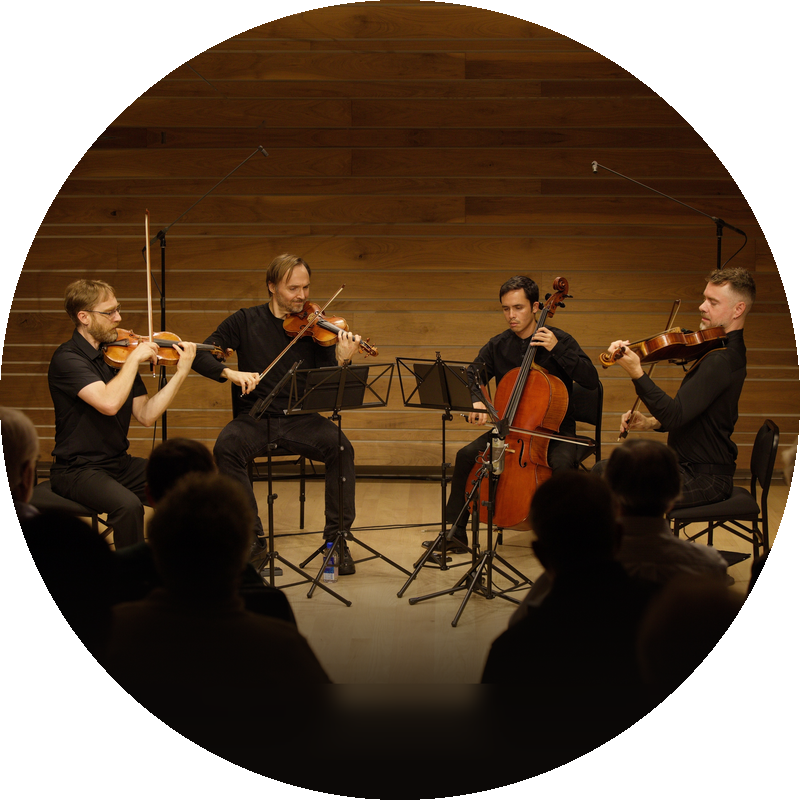
Nova Linea Musica opened season three of its remarkable and innovative music programming with JACK Quartet at Guarneri Hall on Wednesday evening. NLM Artistic Director Desirée Ruhstrat made the opening remarks to a packed audience. She spoke not only as Artistic Director but also as a musician excited about the prospect of a concert from a group steeped in the art of harmonics.

The layers of definition for harmonics are not for the faint of heart. JACK Quartet features musicians immersed in the avant-garde since 2005. Violinists Christopher Otto and Austin Wulliman, violist John Pickford Richards, and cellist Jay Campbell make up the group. Their long history together matters, given the intricate nature of harmonics and the need to intuitively know when phrases change or end. It was fun to listen to and watch the Jack Quartet use subtle head nods and eye contact.
Composer Juri Seo's Dahlia for String Quartet in 13-Limit Just Intonation was the featured new commission for the opening night. I recall some of the music theory from decades ago, but it was all 12-tone equal temperament and mostly focused on Brian Eno and Wendy Carlos. Seo spoke about where she got the idea for the composition, and indeed it was a dahlia. Her work had a brighter feel, with what I describe as a 'fizzy' coda. Dahlias are one of my favorite flowers with their intricate petal patterns. It is a visual metaphor for just intonation.
One of the many laudable things about NLM is that the performers get to choose a composer and commission a new work. This time, Juri Seo wrote Dahlia for String Quartet in 13-Limit Just Intonation. It is exciting to know that an NLM concert is the first time a work is being played in public, and I was there. It is part of music history that future generations may study.
Another composer was in the audience to hear their composition played by JACK Quartet. Keir Gogwilt introduced his Treatise on Limited Freedoms: Future Mode I. Gogwilt's work explores new ways of building off of the Baroque and other traditional classical subgenres. He worked with JACK Quartet as a Studio Artist in Residence and trusted them to play his music authentically.
JACK Quartet opened and closed the concert with two of Cenk Ergün's compositions, Sonare and Celare. Translated from Latin, they mean to hide and make a sound. JACK Quartet began Celare with their fingers above the necks of their instruments in vibrato. Harmonics add movement, timbre, intonation, and tuning to the music, to name a few. Every instrument reacts to harmonics and intonation differently. String instruments are highly sensitive to the slightest movement, and the motions they were making were variations on a note. Think of the sounds in the environment with wind and without. It seemed silent, but it was almost certainly a notation on the score.
Ergün is a Turkish-American composer and uses the makam microtone scale versus the standard Western 12-note scale. Celare begins softly and has a dramatic sound. The microtones sound different depending on the wood used for the instrument. Sonare is also quite dramatic, but it sounded like it had a destination or coda. Ergün wrote both compositions with JACK Quartet. One of the Quartet referred to Ergün's music as the "bread" for the program they were performing. It turned out to be quite a meal.
All four members of JACK Quartet are composers and have recorded together and separately. Violinist Austin Wulliman wrote the penultimate song on the program titled Escape Rites. The composition has six movements, each building on what Wulliman calls a palindromic 25-tone scale. Escape Rites had the driving rhythms of the other pieces. To me, the movement made it easier to visualize the notes and microtones. JACK Quartet mentioned composers John Cage and Pierre Boulez as inspirations and founders of the post WWII contemporary classical music movement into the experimental. The Quartet has followed in their path of multidisciplinary arts and sciences. Some call this music experimental, but I disagree. Cage referred to his music as avant-garde polemic in which sound and silence are not opposite. I prefer Cage's definition.
Harmonics, microtones, intonation, notation, etc. are all part of the art of music, but the analytics, formulas, and theory are science. It's not "easy" music. It is challenging and can be mind-bending to try and follow or catch the parts within the whole. It was a treat to see it all come together at the opening concert for the third season of Nova Linea Musica. The customary panel of artists in conversation with the audience has been moved to after the concert. I like it because it's new music premiering, and questions or comments may flow more easily after the listening experience.
For more information on NLM, please visit https://www.novalineamusica.org/and also visit https://www.jackquartet.com/.

