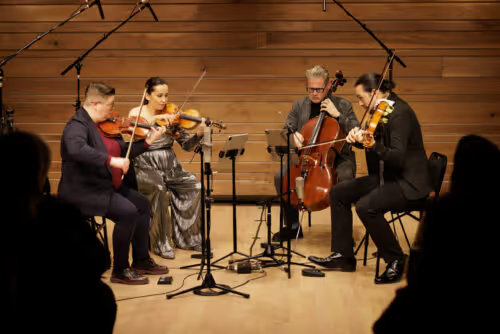
Various, ‘Against All Odds’: Catalyst Quartet (Karla Donehew Perez, Abi Fayette [violins], Paul Laraia [viola], Karlos Rodriguez [cello]). NLM Concert held at Guarneri Hall, Chicago.
Adams – ‘Fellow Traveler’
Sor Juana Inés de La Cruz – ‘Madre la de los primores’
Aftab Darvishi – ‘Daughters of Sol’
Jorge Amando Molina – ‘Tríptico Cubano’
Derrick Skye – ‘Flare and Answer’
Andrea Casarrubios – ‘Unsaying’
Jessie Montgomery – ‘Build’
Coleridge-Taylor Perkinson – String Quartet No.1, ‘Cavalry’
John Adams has a way of claiming the air around him. For the better part of fifty years, his music has defined the sound of American classical life, much as Aaron Copland’s did in the middle of the twentieth century. When a concert begins with Adams and then turns its attention elsewhere, the gesture carries weight. It suggests a quiet resistance: a willingness to acknowledge a dominant voice without letting it set the terms.
At Guarneri Hall the Catalyst Quartet leaned into that tension. Their program, ‘Against All Odds’ (with music commissioned by Nova Linea Musica), opened with Adams’s brisk, six-minute ‘Fellow Traveler’ and closed with Coleridge-Taylor Perkinson’s String Quartet No.1. Between the two stood a constellation of short works by younger composers – world premieres by Derrick Skye and Andrea Casarrubios along with pieces by Jessie Montgomery, Jorge Amando Molina and Aftab Darvishi. The lineup read like a study in how artists carve out space for themselves, whether by confronting the past, reframing inherited forms or simply insisting on their own perspective.
This is familiar territory for the Catalyst Quartet. Founded in 2010, the ensemble emerged from the Sphinx Organization’s efforts to make classical music more diverse by fostering Black and Latino artists and championing composers who do not fit neatly into traditional boxes. In short order, they helped launch the career of Jessie Montgomery, a former member of the ensemble who is today an essential voice in American classical music. With pioneering recordings of string quartets by forgotten and neglected Black composers, the quartet has elevated repertory that others overlooked.
Beginning with ‘Fellow Traveler’ was a clever bit of programming. Written for Peter Sellars, Adams’s longtime collaborator and friend, the piece shows the composer in a lean and lucid mode: bright textures, tight rhythmic interplay and a sense of propulsion that never feels heavy. Placing it first freed the audience from the weight of expectation. Adams’s genius is undeniable, but hearing ‘Fellow Traveler’ at the start cleared space for the other works to unfold on their own terms rather than existing in constant comparison.
Two quieter works followed, functioning as a palette cleanser. Darvishi’s meditative ‘Daughters of Sol’ and the quartet’s arrangement of Sor Juana Inés de la Cruz’s ‘Madre la de los primores’ seem to exist outside the musical norms of the twenty-first century. Under the collective bows of the Catalyst Quartet, they offered a moment of meditative stillness before the quicksilver middle of the program.
That middle section moved with the speed of a series of sketches, but the brevity of the works heightened their impact. Throughout, the Catalyst players offered performances of concentrated energy, giving even the shortest pieces a sense of depth. Molina’s ‘Tríptico Cubano’, the longest of the set, approached Cuba obliquely through a haze of memory that blurred place, time and inheritance. Casarrubios’s ‘Unsaying’ was built from sharp contrasts – phrases that tightened with urgency before breaking off into silences that felt abrupt enough to sting. Skye’s ‘Flare and Answer’ was rhythmically intoxicating, but what made it work was a refusal to treat cross-cultural dialogue as a polite exchange. The shifting rhythms and layered lines suggested a conversation that developed unpredictably, without smoothing over differences. Montgomery’s tiny ‘Build’, a study in repetition and fracture, erupted with a brief, bright intensity that the quartet rendered instinctively.
The evening was anchored by Perkinson’s String Quartet No.1, a work which maintains a restless intelligence that defies easy categorization. While deeply rooted in African-American musical idioms, it remains firmly engaged with the classical quartet tradition. Lyrical passages break easily into pointed rhythmic figures; familiar gestures twist subtly into new shapes. The Catalyst Quartet delivered it with sophisticated ease, emphasizing the music’s fluidity without softening its edge.
Ending with Perkinson felt purposeful. It placed his voice not as a footnote to Adams but as part of a broader American narrative – one that has always included more currents, more histories and more contradictions than the standard telling suggests. Adams remains a defining figure, but the evening made a case for listening beyond the usual musical landmarks. The struggle in the program’s title belonged not only to the composers but to the ongoing effort to widen the frame, to let the landscape of American classical music come into a clearer and more complicated view.

